



SUMMARY
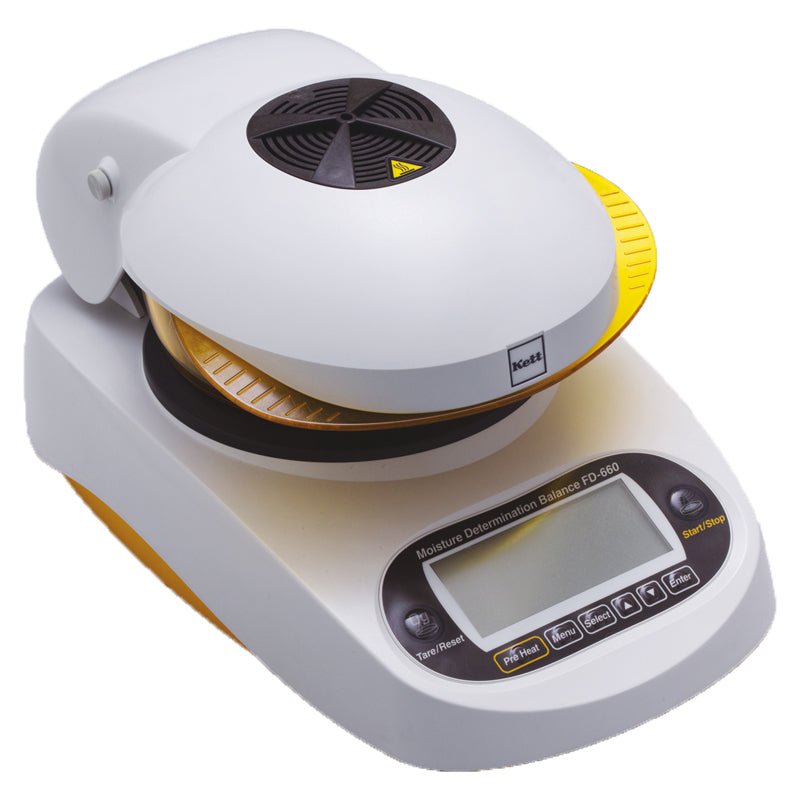
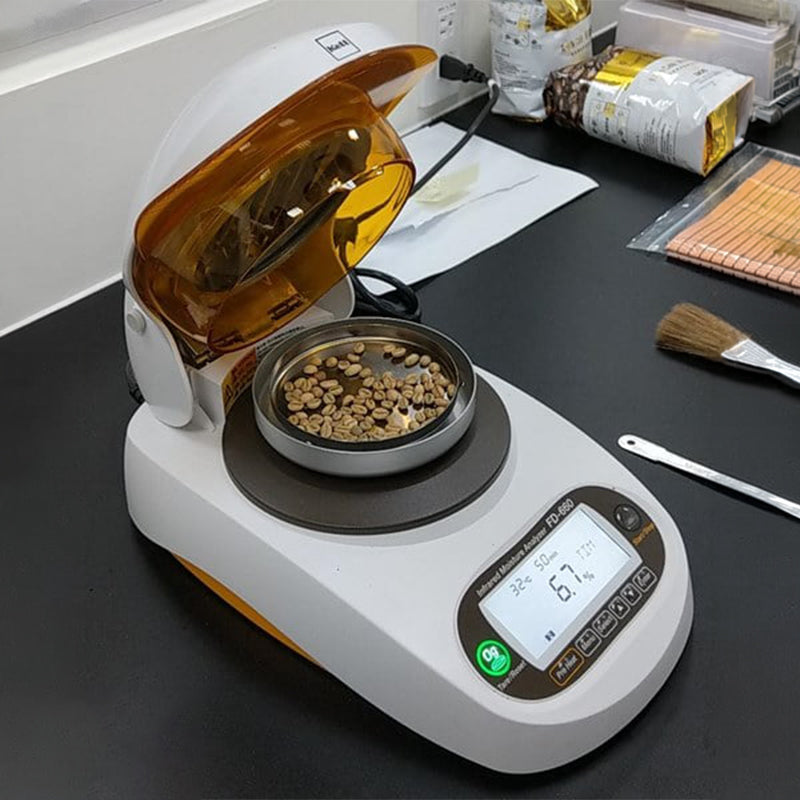
The KETT FD-660 is a general-purpose infrared moisture analyzer that determines moisture or solid content by measuring the loss in sample weight during controlled heating and drying.
Designed as a reliable basic model for routine moisture testing, it can be used with a wide range of materials, including foods, chemicals, sludge, textiles, feathers, and biomass fuels.
FEATURES
- Selectable moisture and solid-content display resolution of 0.1% or 0.01%
- Mass resolution of 0.005 g
- Accepts sample weights from 1 to 80 g
- Auto-tare mechanism continuously corrects the zero point to reduce balance drift during extended measurements
- Organic carbon heaters provide efficient infrared drying
- Adjustable drying temperature from 30 to 180°C in 1°C increments
- Automatic stop mode for ending measurement according to the drying condition
- Timed stop mode adjustable from 1 to 120 minutes
- Pre Heat mode helps stabilize the instrument before measurement
- Stores up to five sets of measurement conditions for different sample types
- Stores up to 50 measurement results for later output
- Backlit 96 × 40 mm LCD
- RS-232C interface for connection to an optional printer or computer data-logging system
- Large stainless-steel sample dish measuring 110 mm in diameter
- Balance calibration function
MEASUREMENT PRINCIPLE
The FD-660 uses the loss-on-drying method. The sample is heated and dried by infrared radiation, and the instrument calculates moisture or solid content from the change in mass caused by moisture evaporation.
Loss-on-drying is a fundamental gravimetric measurement method that is widely used in standard moisture-testing procedures.
ORGANIC CARBON HEATER
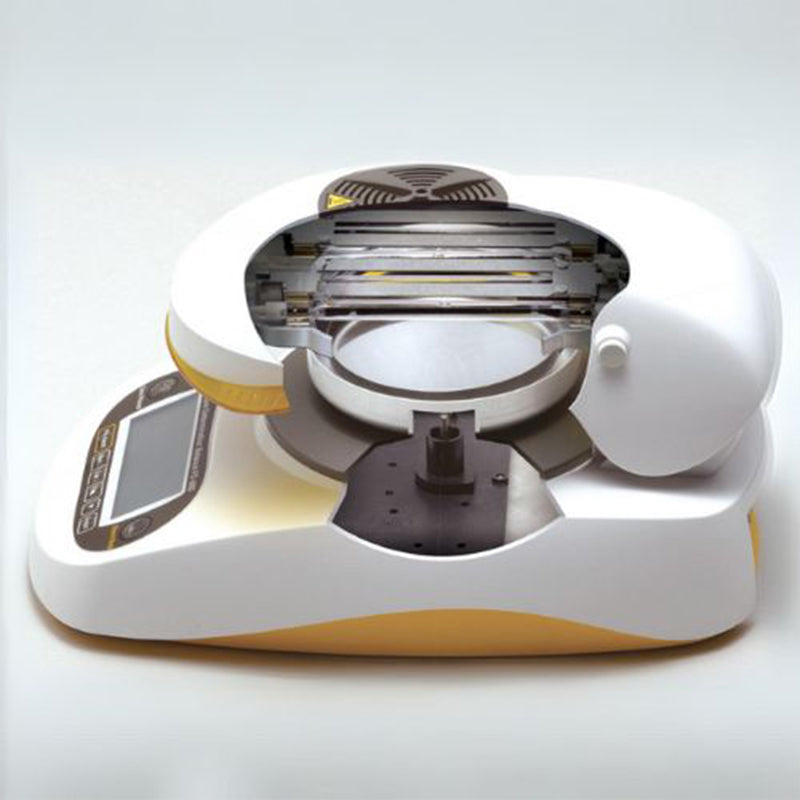
The FD-660 uses two 280 W organic carbon heaters. In the wavelength range where moisture efficiently absorbs infrared energy, the heaters provide effective sample drying.
The heater has a reference operating life of approximately 7,000 hours, which is about four times longer than conventional infrared lamps. This figure represents past heater performance and is not a guaranteed service life.
SUITABLE SAMPLES
The FD-660 can be used with materials that meet both conditions below:
- Heating causes primarily moisture to evaporate from the sample
- Heating does not cause dangerous chemical reactions, combustion, explosion, or the release of hazardous substances
Most materials that meet these conditions can be measured. Appropriate drying temperature, sample quantity, preparation, and stopping conditions should be established for each material.
SPECIFICATIONS
| Model | FD-660 |
|---|---|
| Measurement Method | Loss-on-drying method using heating, drying, and mass measurement |
| Sample Mass | 1 to 80 g Variable sample-mass method |
| Display Resolution |
Moisture content / solid content: 0.1% or 0.01%, selectable*1 Mass: 0.005 g |
| Measurement Range |
Wet-basis moisture content: 0 to 100% Solid content: 0 to 100% Dry-basis moisture content: 0 to 500% |
| Repeatability | Standard deviation of 0.1% with a sample mass of 5 g or more*2 |
| Measurement Modes |
Automatic stop mode Timed stop mode: 1 to 120 minutes |
| Temperature Setting Range | 30 to 180°C in 1°C increments |
| Preheating | Pre Heat mode |
| Measurement Condition Memory | Up to 5 sets of measurement conditions |
| Data Memory | Up to 50 measurement results |
| Display | Backlit LCD, 96 × 40 mm |
| External Interface | RS-232C interface |
| Heat Source | Organic carbon heaters, 280 W × 2 |
| Power Supply | AC100–120 V or AC220–240 V, 50/60 Hz |
| Maximum Power Consumption | 900 W |
| Dimensions | W222 × D360 × H196 mm |
| Weight | Approximately 3.2 kg |
| Sample Dish | Stainless steel Ø110 mm × 11 mm deep |
| Included Accessories |
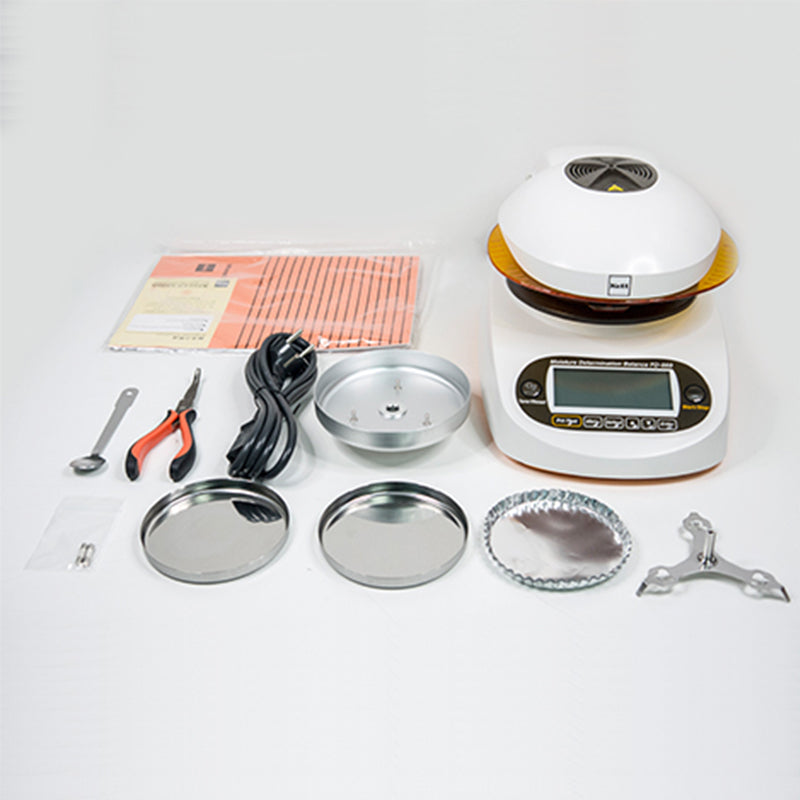
Stainless-steel sample dishes × 2 Sample dish tongs × 1 Windshield × 1 Sample dish holder × 1 Spoon × 1 Spare fuses × 2 Aluminum foil sheets × 10 Power cord × 1 |
*1 The 0.01% setting represents the displayed resolution and does not guarantee measurement accuracy to 0.01%.
*2 Repeatability is based on KETT-specified measurement conditions and standard samples. Actual performance may vary depending on the sample, preparation method, sample mass, and drying conditions.