



SUMMARY
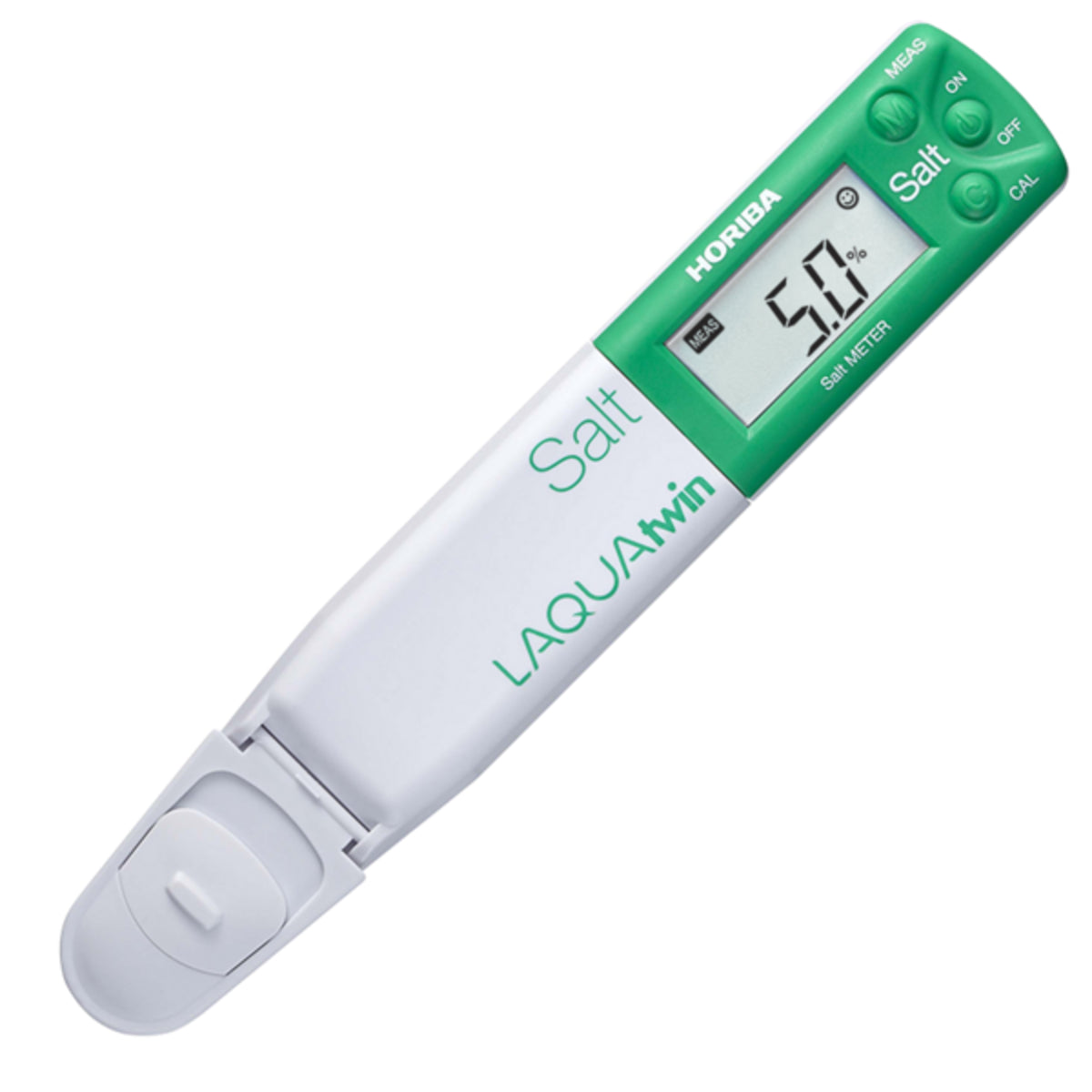
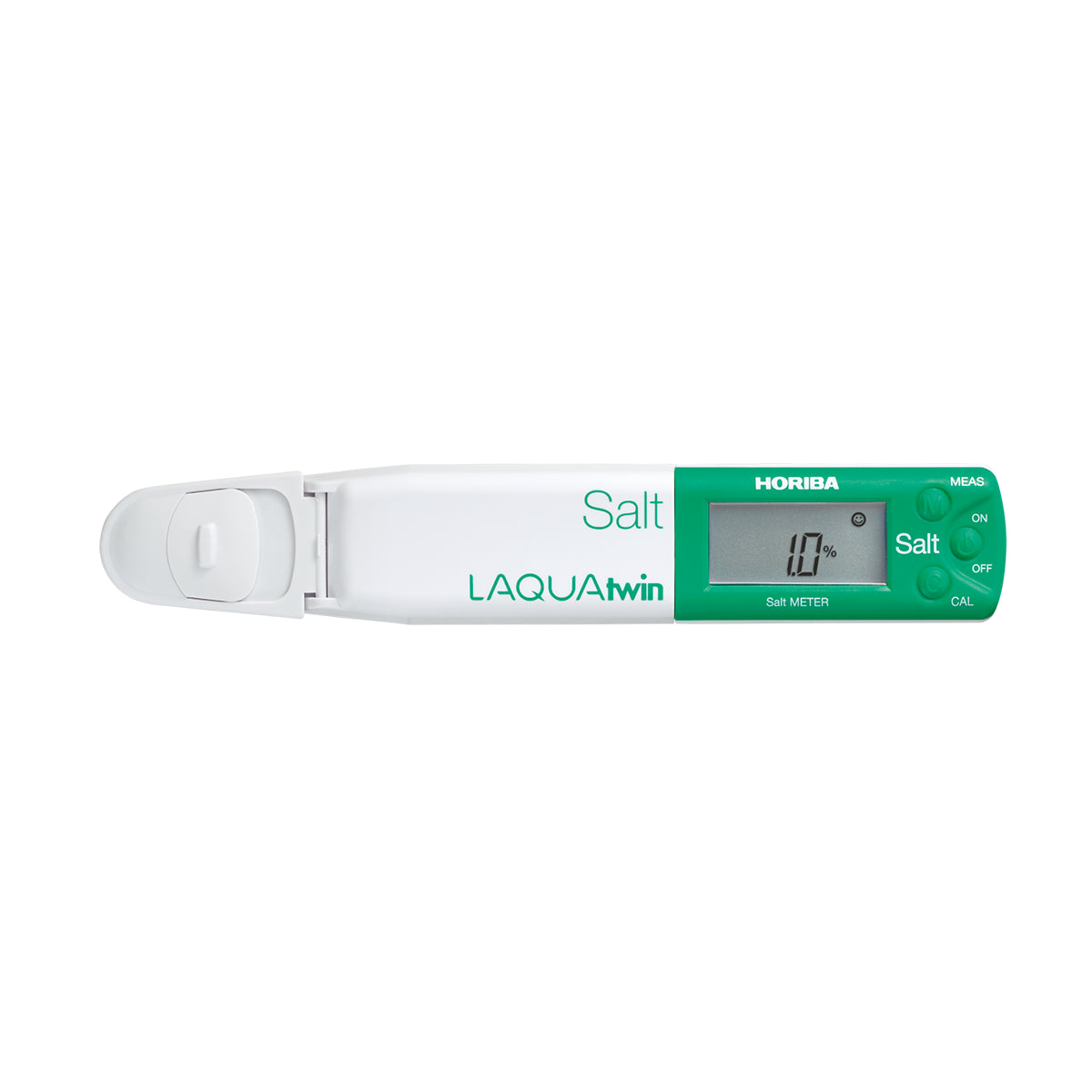
This compact salt meter measures a sample from only 0.3 mL by applying it directly to the flat sensor.
LAQUAtwin's planar sodium ion-selective sensor measures sodium ion concentration and converts the result into sodium chloride concentration as a percentage by weight.
Its portable design makes salt concentration testing convenient for foods, food-processing control, dietary guidance, and sodium management.
FEATURES
- Measures salt concentration from only 0.3 mL of sample
- Measurement possible from 0.05 mL when using Sampling Sheet B
- Flat sodium ion-selective sensor with excellent selectivity
- Converts sodium ion concentration into sodium chloride concentration as weight percentage
- Wide measurement range from 0.01 to 25% by weight
- Up to two calibration points
- Low- and high-concentration calibration points can be adjusted
- Temperature sensor adjustment function
- Auto Hold function
- Auto Stability function
- Backlit monochrome digital LCD
- Automatic power-off after 30 minutes
- Remaining battery level display
- IP67 water-resistant construction
- Replaceable sensor
- Portable storage case and measurement accessories included
VERSATILE SAMPLING METHODS
LAQUAtwin's flat-sensor design allows samples to be applied or collected in several convenient ways. Choose the method that suits the sample and measurement purpose.
Direct Drop Measurement
Apply a liquid sample directly to the flat sensor with a syringe, pipette, or dropper. The Salt-22 requires at least 0.3 mL for direct measurement. Sampling Sheet B allows measurement from as little as 0.05 mL.

Immersion Measurement
For liquid samples in a beaker or container, the sensor can be immersed directly in the sample. Open the sliding cap on the sensor guard before measurement.

Scoop Sampling
The sensor guard can be used to scoop a liquid sample directly from a tank, food-processing container, or other sampling location for convenient on-site measurement.

Moist Solid Samples
Moist solid samples such as foods can be cut into small pieces and placed directly on the flat sensor when sufficient liquid makes contact with the electrode.

Powder Samples
Place the powder sample on the flat sensor and add a fixed amount of pure water before measurement. Keep the sample amount and water volume consistent when comparing results.

Paper, Textiles, and Sheet-like Samples
Cut the sample into small pieces, place them on the flat sensor, and add a fixed amount of pure water to measure sodium extracted from the material.

SPECIFICATIONS
| Model | LAQUAtwin-Salt-22 |
|---|---|
| Measurement Principle | Ion-selective electrode method |
| Required Sample Volume |
0.3 mL or more Measurement from 0.05 mL is possible when using Sampling Sheet B*1 |
| Measurement Range | 0.01 to 25% by weight |
| Resolution |
0.00 to 0.99%: 0.01% by weight 1.0 to 9.9%: 0.1% by weight 10 to 25%: 1% by weight |
| Temperature Display Range / Resolution | 0 to 50°C / 0.1°C |
| Calibration | Up to 2 points |
| Accuracy | ±10% of the reading*2 |
| Main Functions |
Adjustable low- and high-concentration calibration points Temperature sensor adjustment function Auto Hold Auto Stability function Automatic power-off after 30 minutes Remaining battery level display Replaceable sensor |
| Water Resistance | IP67 equivalent*3 |
| Display | Custom monochrome digital LCD with backlight |
| Operating Environment | 5 to 40°C, 85% relative humidity or less, non-condensing |
| Power Supply | Two 3 V CR2032 coin-type lithium batteries |
| Battery Life | Approximately 400 hours of continuous use with the backlight switched off*4 |
| Main Material | ABS resin |
| Dimensions and Weight |
W164 × H29 × D20 mm, excluding protruding parts Approximately 50 g, excluding batteries |
| Included Accessories |
S021 salt sensor Two CR2032 coin-type lithium batteries One syringe Instruction manual Quick manual Storage case 0.5% NaCl standard solution, 14 mL × 1 bottle 5.0% NaCl standard solution, 14 mL × 1 bottle Sampling Sheet B × 5 sheets |
| Main Consumables |
S021: Salt sensor 514-50: 5.0% NaCl standard solution 514-05: 0.5% NaCl standard solution |
*1 Measurement is possible from 0.05 mL when using Sampling Sheet B. Close the sensor cover during measurement. For samples containing fine particles, use a separate sampling-sheet retaining cover.
*2 Indicates repeatability when the same standard solution is measured after calibration with that standard solution. Error in the standard solution and rounding error of ±1 digit are not included.
*3 Equivalent to IP67. The meter will not fail after immersion in water at a depth of 1 m for 30 minutes. It cannot be used underwater.
*4 Battery life is reduced to approximately one-third when the backlight is used. The backlight remains illuminated for approximately 20 seconds.
Salt Concentration Measurement Notes
The Salt-22 responds to sodium ions and converts the measured sodium ion concentration into sodium chloride concentration as a percentage by weight.
The displayed value is a calculated sodium chloride equivalent. It is not a direct gravimetric measurement of all salts contained in the sample.
Samples containing sodium compounds other than sodium chloride may produce a displayed salt value that differs from the sample's actual sodium chloride concentration.
Ions other than sodium contained in the sample may also affect the measurement. The interference characteristics are based on those of the sodium ion-selective sensor.
For quantitative comparisons, keep the sample preparation, dilution or extraction ratio, temperature, calibration procedure, and measurement conditions consistent.